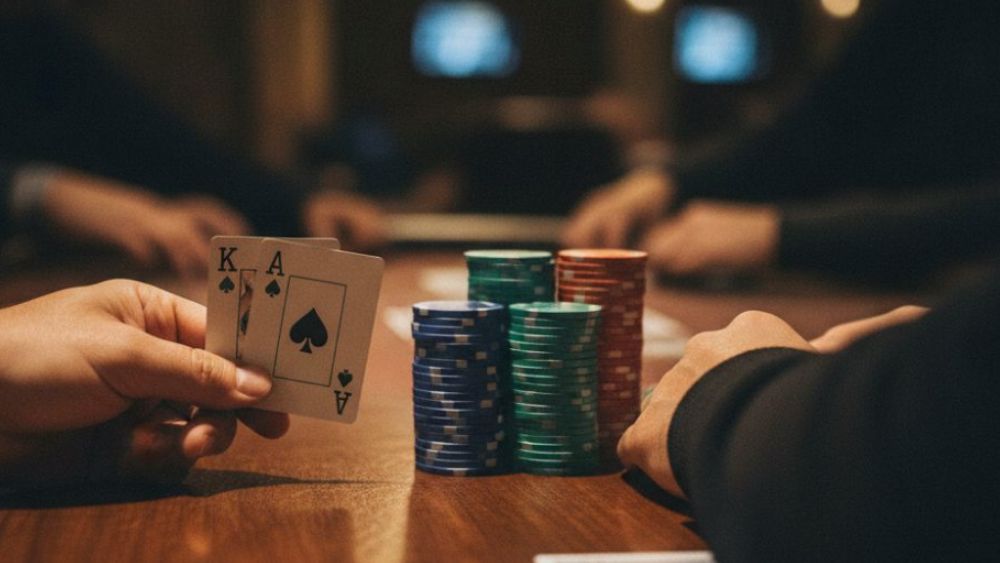
Why Blackjack Players Keep Hearing About "Basic Strategy"
Walk into any Philippine online casino lobby and blackjack sits there quietly beside the louder games. No spinning wheels, no flashing reels, no bonus rounds. Just cards, a dealer, and a decision you have to make in seconds. That is exactly why basic strategy matters more here than in almost any other table game.
Basic strategy is not a hunch or a "feel the table" system. It is a fixed set of decisions — hit, stand, double, split, or surrender — calculated from every possible combination of your two cards against the dealer's one visible card. Mathematicians crunched the numbers decades ago, and the resulting chart has barely changed because the rules of blackjack have barely changed.
Follow it perfectly, and you shave the house edge down to roughly 0.5% on a standard 8-deck game with decent rules. Ignore it, play by gut, and you can hand the casino a 2% to 4% edge without realising it. On a ₱5,000 session, that gap is the difference between a long night and a short one.
The catch? Basic strategy is not about winning every hand. It is about losing less over thousands of hands. Anyone who promises you guaranteed profits at blackjack is selling something, not teaching something.
The Core Decisions, Broken Down
You only ever make five choices at the table. Learn what triggers each one and the chart becomes far less intimidating than it looks.
Hit or Stand
This is the bulk of basic strategy. The rule of thumb: assume the dealer's hole card is a 10, because in a fresh shoe it usually is statistically the most likely card. So if the dealer shows a 7 or higher, you are playing defence — you need 17 or more to have a realistic shot.
- Hard 17 and above: always stand. No exceptions, no "but I have a feeling."
- Hard 12 to 16: stand if the dealer shows 2 through 6, hit if the dealer shows 7 or higher. The dealer busts often enough against low cards that you win by doing nothing.
- Hard 11 or lower: always hit, unless a double is available and smart.
Soft hands — those with an Ace counted as 11 — are where beginners panic. A soft 18 (Ace-7) is not a strong hand. Against a dealer's 9, 10, or Ace, you should hit it. That feels wrong until you see the math: an 18 loses to a dealer 19 or 20, and standing on it just locks in the loss.
Doubling Down
Doubling means one more card and double the bet. Basic strategy is aggressive with it because you only double when you are genuinely ahead.
- Hard 11: double against everything except a dealer Ace in most rule sets.
- Hard 10: double against dealer 2 through 9.
- Hard 9: double against dealer 3 through 6.
- Soft 13 to 18: double against dealer 4, 5, or 6 — the dealer's weakest cards.
If the table does not allow doubling after a split, adjust your chart accordingly. Rule variations matter, and Philippine-facing sites differ on this.
Splitting Pairs
Not all pairs deserve a split. The chart is surprisingly picky:
- Aces and 8s: always split. Two Aces make two strong starting hands; 16 is the worst hand in blackjack.
- 10s and 5s: never split. 20 is excellent, and 10 is a fine doubling hand.
- 9s: split against dealer 2 through 6, plus 8 and 9. Stand against 7, 10, and Ace.
- 4s: only split against a dealer 5 or 6, and many charts skip it entirely.
Surrender
If the game offers late surrender, use it on hard 16 against a dealer 10 or Ace, and hard 15 against a dealer 10. You give back half your bet and move on. It is a small, unglamorous leak-plug that most casual players ignore.
Does Basic Strategy Change With Online Rules?
Yes, and this is where Philippine online players get tripped up. Land-based tables in Manila and Cebu often deal 6 or 8 decks with the dealer standing on soft 17. Many online tables, especially live-dealer ones, are configured differently.
Three rule variations do most of the damage:
- Dealer hits soft 17: adds about 0.2% to the house edge. Your chart barely changes, but your long-term results do.
- No doubling after split: costs you roughly 0.15%. Adjust by not splitting marginal pairs like 4s.
- Blackjack pays 6:5 instead of 3:2: this is the big one. It adds about 1.4% to the house edge, wiping out most of your basic strategy gains. Avoid these tables unless the side bets or comps genuinely compensate.
Before you sit down at any online table, read the rules panel. It takes thirty seconds and it tells you whether the game is worth your time. A 6:5 blackjack table with a hit-soft-17 dealer is not the same game as a 3:2 table where the dealer stands on all 17s.
If you only remember one thing: the blackjack payout rule matters more than any single decision you make at the table.
How Much Does It Actually Save You?
Numbers make this concrete. Take a player betting ₱100 a hand for 500 hands — a reasonable weekend session.
Playing purely by instinct, a typical casual player faces a house edge around 2%. Expected loss: about ₱1,000. Play perfect basic strategy at a good 3:2 table, and the edge drops to roughly 0.5%. Expected loss: about ₱250.
That is a ₱750 difference from the same bets, the same luck, the same session length. Over a year of regular play, the gap runs into tens of thousands of pesos. Basic strategy does not make you a winner, but it makes your bankroll last dramatically longer — and longer sessions mean more chances to hit a hot run.
It also keeps you calm. When you already know the correct play, you stop agonising over a 15 against a dealer 10. You just do it and move on.
Learning the Chart Without Burning Money
You do not need to memorise a 300-cell grid before you play. Three practical approaches work for most Filipino players:
- Use the free-play tables first. Most Philippine online casinos offer demo blackjack. Play 200 hands with the chart open beside you. Muscle memory kicks in faster than you expect.
- Drill the common situations. Hard 12–16 against a dealer 2–6, and hard 12–16 against 7–Ace. Those two groups cover a huge share of your decisions.
- Keep a chart on your phone. It is not cheating to consult a strategy chart. It is studying. Just do not slow the table down excessively in a live-dealer game — other players notice.
Skip the card-counting videos for now. Counting works in theory, but online shoes are shuffled frequently, penetration is often poor, and live-dealer games move at a pace that makes tracking impractical for most people. Basic strategy alone gets you 90% of the available edge reduction with none of the heat.
One last habit worth building: set a loss limit before you log in, and treat it as fixed. Basic strategy protects your edge, not your discipline. Those are two different skills, and the second one decides whether the first one ever pays off.
Frequently Asked Questions
Is blackjack basic strategy legal to use in Philippine online casinos?
Yes. Basic strategy is just a set of decisions based on your cards and the dealer's upcard. It is not a device or a system, so there is nothing to prohibit. Many casinos even publish the chart themselves.
Does basic strategy guarantee I will win?
No. It reduces the house edge to around 0.5% on good tables, but the casino still holds a mathematical advantage over time. Think of it as losing slower and playing smarter, not as a profit plan.
Should I always split Aces and 8s?
In standard blackjack, yes. Splitting Aces gives you two strong starting hands, and splitting 8s avoids the worst total in the game. The only exception is a table that restricts resplitting Aces, which changes the value slightly.
What is the biggest rule to check before playing online blackjack?
The blackjack payout. Tables paying 6:5 instead of 3:2 add roughly 1.4% to the house edge and erase most of your basic strategy gains. Always confirm the payout before you place a bet.